
Last updated July 15, 2026
Seasonal Gate Repair Care for Sacramento: Year-Round Homeowner’s Guide
The week after Sacramento’s first hard rain in November is the single busiest service period of the year for gate repair calls — and nearly every one of those calls traces back to something a 20-minute October walkthrough would have caught. A swollen weld point. A dead operator battery. A drain channel clogged with summer dust. Sacramento’s climate doesn’t wear your gate down evenly across twelve months — it hits in two concentrated stress cycles, and if your maintenance calendar doesn’t match that reality, you’re spending time on the wrong things while the real damage compounds quietly. Our Gate Repair Maintenance Checklist for Sacramento Homeowners restructures seasonal care around how Sacramento’s weather actually works.
Quick Answer
Seasonal gate care in Sacramento comes down to two critical windows: October (pre-rain prep) and April–May (pre-heat prep). Because Sacramento’s climate is defined by prolonged dry heat followed by brief, intense wet cold rather than four gradual seasons, those two transition months carry the highest risk of gate failure. A 90-minute annual inspection split across those windows — covering hardware, operator electronics, drainage, and weathersealing — catches the majority of issues before they become emergency calls.
Table of Contents
- How Sacramento’s Climate Actually Works Against Your Gate
- Pre-Summer Checklist: April–May Thermal Expansion Prep
- Mid-Summer Check: What 105°F Heat Does to Hydraulic Closers
- Pre-Rain Prep: October Is the Most Important Maintenance Window
- Tule Fog Protocol: December–January Corrosion You Can’t See Coming
- How to Build a 90-Minute Annual Walkthrough Into Your Calendar
- Common Mistakes to Avoid
- When to Call a Professional
- Frequently Asked Questions
- The Bottom Line
How Sacramento’s Climate Actually Works Against Your Gate
Most gate maintenance advice is written for a generic four-season climate — a little of everything spread evenly across the year. Sacramento doesn’t work that way. What we actually get is a Mediterranean two-stress cycle: five to six months of progressively intensifying dry heat, followed by a compressed wet season that arrives fast and often cold. The Valley’s position means UV radiation is intense and sustained, ambient temperatures regularly exceed 100°F in July and August, and then October through February delivers rain, ground saturation, and the region’s signature tule fog.
For a gate system, those two extremes attack completely different components. Summer heat degrades rubber seals, stresses operator electronics, and causes iron and steel to thermally expand in ways that shift alignment. The wet season then finds every micro-crack the heat opened, drives moisture into weld points and contact terminals, and saturates soil around gate posts. Neighborhoods across Sacramento — from Elk Grove’s newer subdivisions to the older estate gates you’ll find in Arden-Arcade — see the same two-phase failure pattern regardless of gate brand or age.
Understanding this cycle is the foundation of every maintenance decision. If you’re lubricating hinges in August because it’s on a generic quarterly checklist, you’re not wrong — but you’re also not addressing the higher-priority risks Sacramento’s specific environment creates. This guide prioritizes by actual local impact.
Pre-Summer Checklist: April–May Thermal Expansion Prep
April and May are your setup window. Temperatures are climbing but haven’t yet hit the extremes that push components to their limits. Everything you do now determines how your gate performs through the four hardest months of the Sacramento year.
Iron Gate Thermal Expansion Prep
Iron and steel expand measurably in Sacramento’s summer heat. A wrought-iron driveway gate that fits its frame perfectly at 65°F in March can bind against posts or strike plates by the time July arrives. The fix isn’t complicated, but it requires knowing what clearances to check before the heat sets in.
- Check the gap between the gate leaf and each post at the top and bottom — you want consistent clearance, typically 3/8 to 1/2 inch on each side for a standard residential swing gate.
- Run the gate through a full open and close cycle and listen for any scraping or hesitation — friction that’s minor now will worsen significantly at 100°F.
- Inspect weld points along the frame perimeter for hairline cracks — thermal cycling accelerates existing fractures, and a small crack in April is a broken hinge bracket in August.
- Apply a high-temperature-rated lubricant (not WD-40) to all hinge pins, rollers, and pivot points — standard lubricants thin out and run off in Sacramento heat.
Operator Battery Capacity Test
Gate operator batteries — the backup units inside LiftMaster, Ghost Controls, Viking, and similar systems — lose effective capacity in extreme heat. A battery that reads 12 volts on a cool morning can fail to hold adequate voltage under the thermal load of a July afternoon. Test battery health in April with a load tester, not just a voltmeter reading at rest. Most residential operator batteries should be replaced every two to three years regardless of how they test, and Sacramento’s heat compresses that timeline.
Control Board UV and Shade Audit
Control boards mounted in direct western sun exposure are consistently the first to fail. In May, walk the perimeter of your gate system in the late afternoon and observe where direct sunlight hits your operator cabinet. If the cabinet face is in full afternoon sun for more than two hours daily, adding a simple shade shield or relocating the enclosure dramatically extends board life. We’ve seen FAAC and BFT control boards on the west-facing walls of Sacramento properties fail in three to four years — the same boards on shaded installations routinely last eight or more.
Mid-Summer Check: What 105°F Heat Does to Hydraulic Gate Closers
By July, the question isn’t whether heat is stressing your gate system — it’s whether a specific component is approaching failure. Mid-summer checks are brief and targeted. You’re not doing a full inspection; you’re watching for two or three high-probability failure points.
Hydraulic Closer Seals
Hydraulic gate closers — common on commercial and heavy residential swing gates — use pressurized fluid to control close speed. At sustained temperatures above 95°F, hydraulic fluid expands and the seals that contain it come under pressure stress. A failing seal announces itself with a specific pattern: the gate begins closing faster than its set rate, often with a slight jerk at the midpoint of the swing. You may also notice a faint oily residue around the closer body where fluid is seeping.
Catch it here and it’s a seal replacement — typically a straightforward Gate Repair. Miss it and the seal blows completely, leaving the gate either slamming uncontrolled or hanging open with no resistance at all. In Sacramento’s commercial corridors, that’s a liability exposure, not just a maintenance issue.
What to Check in July
- Open and close the gate manually (with the operator disengaged) and observe how the hydraulic closer behaves through the full arc.
- Look for any oil staining or residue on the closer body and mounting bracket.
- Check the gate’s close speed against what it was set to — if it’s noticeably faster, the seal is losing containment.
- Feel the operator cabinet surface temperature in mid-afternoon. If it’s too hot to hold your hand on comfortably, ventilation is inadequate and your control board is running at risk.
A full motor or opener service from a specialist who knows systems like Elite or DoorKing access control units will also catch issues with solenoids and wiring insulation that heat accelerates. This isn’t the time for a general handyman — the diagnostic matters as much as the part.
Pre-Rain Prep: October Is the Most Important Maintenance Window in Sacramento
If you do only one maintenance check per year, do it in October. This is the window that prevents the November call spike. Sacramento’s rainy season typically arrives in force between late October and early December, and the gate components most likely to fail in wet conditions are entirely predictable — and entirely addressable in a dry-weather inspection.
Soil Drainage Around Gate Posts
Gate posts set in concrete piers depend on adequate drainage to prevent soil saturation from shifting the foundation. Sacramento’s clay-heavy soils — particularly common in areas like Natomas and parts of South Sacramento — expand significantly when saturated, and that expansion can push a post laterally by as much as a quarter inch over a single wet season. On a swing gate, that movement translates directly into misalignment, binding, and eventually a failed latch or damaged hinge.
In October, clear any debris, soil buildup, or plant growth from the base of each post. Check that the grade slopes away from the post on all sides. If water is pooling within 18 inches of the post base after a hose test, it’ll pool after a December rain — and then freeze overnight and expand further.
Rust-Prone Weld Points
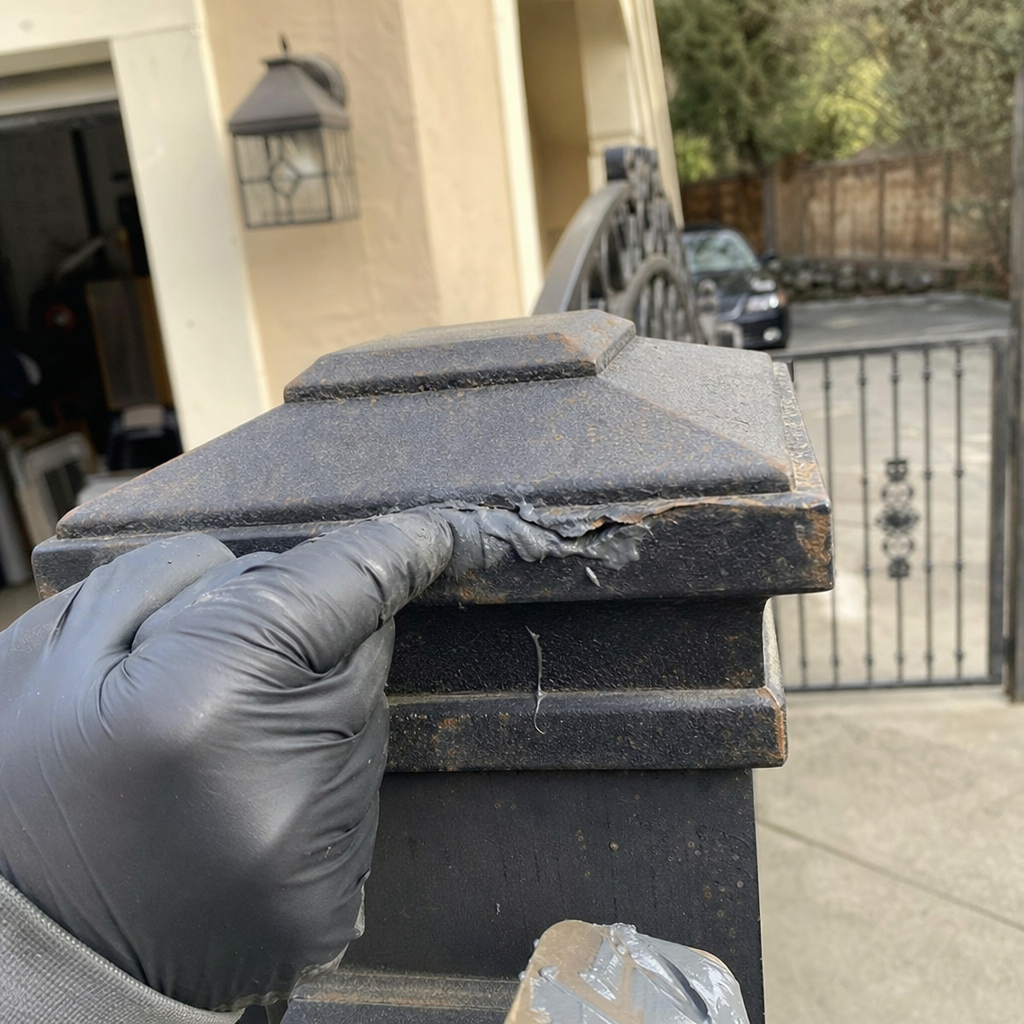
Bare metal at weld joints is the entry point for seasonal rust. The heat of welding burns off paint and primer in a small radius around each joint, and if that area wasn’t properly touched up after fabrication or a previous repair, it’s been accumulating surface oxidation through every Sacramento summer. When the rains hit, that surface rust becomes active corrosion — fast. In October, run your hand along every weld point on the gate frame and look for orange discoloration, roughness, or bubbling in the surrounding paint. Sand, treat with a rust converter, and reprime before the first rain. This is a 45-minute task that prevents a structural repair call in February.
Weatherseal Integrity
The foam or rubber weatherseal along the bottom and sides of sliding gate systems takes the most abuse from seasonal transitions. It hardens, cracks, and compresses permanently over time. In October, press on the seal along its full length — it should compress and spring back evenly. Any section that crumbles, stays compressed, or has visible cracking won’t keep water from wicking into the gate track or along the bottom rail. Sliding gate tracks fill with debris and water when the seal fails, which accelerates rack-and-pinion wear on operators like Linear or Mighty Mule systems that run exposed drives.
Tule Fog Protocol: December–January Corrosion You Can’t See Coming
Sacramento’s tule fog is one of the most climatically specific challenges a gate system faces anywhere in California. Unlike coastal marine fog, tule fog forms at ground level in the Central Valley and can persist for days or weeks without lifting — blanketing an entire gate system in sustained low-level moisture at temperatures between 35°F and 50°F. That combination doesn’t produce the dramatic failures that summer heat or hard rain creates. It produces slow, invisible corrosion that you find three months later wondering why a connection stopped working.
What Tule Fog Attacks
- Electrical contact points: Key switches, loop detector terminals, safety edge connectors, and intercom wire terminations oxidize slowly in sustained low-moisture air. A DoorKing or Linear access control system that worked perfectly in October can develop erratic behavior by January from nothing more than corroded screw terminals.
- Battery terminals: The lead posts on backup batteries accumulate a white sulfate buildup in fog conditions that increases resistance and reduces effective charge delivery — your gate may open slowly or incompletely even with a battery that technically holds voltage.
- Unpainted mild steel: Any bare steel introduced by a repair, a new mounting bracket, or a worn paint edge that made it through October will develop active rust within four to six weeks of tule fog exposure.
The December Check — 15 Minutes
- Open your operator cabinet and visually inspect all terminal strip connections — look for white or green oxidation on copper wire ends and screw terminals.
- Inspect battery terminals for white powdery buildup and clean with a terminal brush if present.
- Spray all exposed electrical connections with a dielectric grease or contact protector spray — this doesn’t fix corrosion, but it seals out further moisture penetration.
- Walk the full gate perimeter and mark any bare steel spots you see — address with rust converter and a spray primer on any dry day you get.
How to Build a 90-Minute Annual Walkthrough Into Your Calendar
A full annual inspection doesn’t need to happen all at once. Given Sacramento’s two-stress-cycle climate, splitting the effort across two calendar anchors is more effective and less likely to get skipped.
Set Two Calendar Reminders — Not Four
Quarterly maintenance schedules work in theory; in practice, most homeowners complete one or two before life intervenes. Two reminders, tied to Sacramento-specific events, are more likely to stick:
- First weekend of April: Pre-summer inspection (thermal expansion, battery load test, UV audit, lubrication)
- Columbus Day weekend in October: Pre-rain inspection (drainage, weld points, weatherseal, control board)
The December tule fog check takes 15 minutes and can be added as a brief walk-around after your October inspection surfaces any new concerns. The July check is another 15-minute targeted look at hydraulic closers and cabinet temperature — not a full inspection, just the two or three heat-specific failure points.
The 90-Minute Walkthrough Sequence
- Visual pass (10 min): Walk the full gate perimeter at close range. Look at every weld point, hinge, wheel, and roller. Don’t touch yet — just observe and note anything that looks off.
- Hardware check (20 min): Test all hinges for play, check gate alignment at latch and stop points, inspect post bases for movement, check all mounting hardware for tightness.
- Operator and electronics (20 min): Open the cabinet, inspect terminals and battery, run the gate through 5 complete cycles while observing speed and behavior, test all safety reversal sensors.
- Weatherproofing and drainage (15 min): Check weatherseal condition, clear debris from track or hinge area, verify post base drainage, apply lubricant to all moving parts.
- Finish and note (10 min): Document anything that needs follow-up — a photo on your phone with a date is enough. Schedule any repair before the next weather transition, not after.
If your gate is part of a broader access control setup — keypad, intercom, loop detectors — add 15 minutes to test each input and output. A Gate Motor & Opener in Parkway check by a specialist once every two to three years supplements the homeowner walkthrough with the diagnostic tools to catch what a visual inspection can’t.
Common Mistakes to Avoid
- Using WD-40 as a long-term lubricant on gate hardware. WD-40 is a water displacer, not a lubricant — it attracts dust and gum up hinges within weeks in Sacramento’s summer conditions. Use a white lithium grease or a silicone-based product rated for outdoor metal-to-metal contact.
- Testing gate operation by remote only. A remote test doesn’t reveal slow close speed, dragging at a hinge, or a safety edge that’s lost sensitivity — walk the gate through a full cycle on foot, watching and listening, at least twice per inspection.
- Skipping the October inspection because the summer went fine. Summer heat and dry-season performance tell you nothing about how weld points, seals, and post drainage will handle saturation. The failure modes are completely different — and October prep is the only window that addresses them before they trigger.
- Ignoring gate post movement as “seasonal settling.” In Sacramento’s clay-soil areas — Natomas, Meadowview, parts of North Highlands — post movement from soil expansion is real and cumulative. A gate that’s “a little off” in November may be inoperable by February. Post movement should be documented and monitored, not dismissed.
- Painting over rust without treating it first. Surface rust under paint continues to spread and will bubble through within one wet season. Always use a rust converter on bare oxidized steel before priming — especially on weld joints and hinge areas where the metal profile traps moisture.
- Replacing the operator without diagnosing the underlying cause. A gate motor that’s burning out prematurely is often fighting a mechanical problem — a misaligned post, a dragging roller, a binding latch. Replacing the operator without fixing the root cause means replacing it again in 18 months. This is where brand-specific diagnostic knowledge on systems like LiftMaster or FAAC actually matters.
- Assuming new gate installation resets the maintenance clock to zero. New installs — whether a Viking swing gate or a BFT sliding system — still need a first-year inspection after one full Sacramento weather cycle. That cycle will surface any installation-specific quirks in post drainage, alignment, or cable routing before they become structural.
When to Call a Professional
Handle the walkthrough checklists above yourself — or explore more guides & resources designed for a homeowner with basic tools and a couple of hours. Call a specialist when you encounter any of the following:
- Visible cracks at weld joints or structural connections — these require welding, not patching.
- A gate post that has shifted more than 1/4 inch from vertical or plumb — post resetting involves concrete work and should be done before the wet season, not during it.
- An operator that runs but doesn’t complete the full cycle, or reverses unexpectedly — this is a diagnostic problem, not a reset problem.
- Any electrical fault, burning smell, or tripped breaker associated with the gate operator.
- A hydraulic closer with visible fluid leakage — the seal replacement window is narrow before the unit needs full replacement.
Next Gen Gate Repair Sacramento offers free estimates in Sacramento — call (279) 239-2652 and Gary will tell you directly whether it’s a repair, a part, or something you can handle yourself. No upsell pressure, no guesswork.
Frequently Asked Questions
How often should I have my gate serviced in Sacramento?
A full professional service once every two years is a reasonable baseline for most Sacramento residential gates, supplemented by the two homeowner walkthrough windows described above — April and October. Gates with high daily cycle counts, older hydraulic components, or significant UV exposure may need annual professional attention. Call (279) 239-2652 for an honest assessment of your specific system.
Why does my gate work fine all summer but fail right after the first fall rain?
Summer’s dry heat and the wet season attack completely different components. Heat stresses electronics and rubber seals; rain finds the rust, drainage problems, and weld cracks that the heat quietly opened. A gate that performs well in August can have three or four weather-exposed failure points already developing that only become active when moisture arrives. The October pre-rain inspection exists specifically to catch those before they trigger.
What does thermal expansion actually do to an iron gate in Sacramento summers?
Steel expands roughly 6 to 7 thousandths of an inch per foot per 100°F temperature rise. A 12-foot iron gate that fits its frame correctly at 65°F in March has expanded enough at 105°F in July to bind against posts, stress hinges, or prevent the latch from engaging cleanly. That binding forces the operator to work harder, accelerating motor wear on LiftMaster or Elite systems over time. The fix is confirming adequate clearance in spring before expansion becomes a problem.
Is tule fog really that different from regular rain when it comes to gate damage?
Yes — and most generic maintenance advice misses this entirely. Rain is episodic; tule fog is sustained. Days of continuous low-level moisture at near-freezing temperatures corrode electrical terminals and battery contacts in ways that occasional rain followed by dry periods doesn’t. Sacramento’s December and January fog events are specifically responsible for a category of access control failures — intermittent keying errors, slow response, erratic reversal — that look like software problems but are actually corroded wire terminations.
Can I repair a gate post that has shifted, or does it need full replacement?
In most cases, a shifted post can be reset and re-poured without replacing the entire gate. The answer depends on how far it’s moved, whether the concrete pier cracked, and whether the gate frame itself absorbed the movement. Gary Young has seen Sacramento clay-soil post shifts that reset cleanly and others where the footing needed to be excavated and repoured. Get a professional diagnosis before assuming replacement — the repair is almost always less expensive. Call (279) 239-2652 for a free on-site assessment.
Do different gate brands need different seasonal maintenance steps?
The mechanical walkthrough is largely the same across brands — hinges, alignment, drainage, and weatherseal don’t change based on who made the operator. Where brands diverge is in electronics diagnostics and parts availability. A Ghost Controls or Mighty Mule residential opener has different battery management behavior than a FAAC or BFT commercial unit, and the failure signatures look different. For the homeowner walkthrough sections of this guide, brand doesn’t change the steps. For anything involving the operator’s internal behavior or access control programming, brand-specific knowledge matters — and it’s why a specialist who works across all nine major platforms diagnoses faster and more accurately than someone who only knows one or two.
The Bottom Line
Sacramento’s gates don’t wear out evenly — they wear out in two concentrated bursts tied to the Valley’s heat-to-wet-season transition. The homeowners who avoid emergency repair calls are the ones who’ve shifted their maintenance calendar to match: a pre-summer inspection in April and a pre-rain inspection in October, with quick 15-minute targeted checks in July and December. That’s roughly 90 minutes of intentional attention per year, split across four calendar anchors. It won’t prevent every gate failure — nothing does — but it catches the predictable ones before they become expensive surprises. For the repairs that go beyond a homeowner walkthrough, a specialist with 11 years of Sacramento experience and in-house welding capability is worth the call. Gate Repair in Parkway and surrounding Sacramento neighborhoods is what Next Gen Gate Repair does, every day, with Gary on the job — not a subcontractor. For new systems, see Gate Installation in Parkway for what a properly spec’d, Sacramento-climate-aware install looks like from the start.
Ready to schedule your pre-season inspection or get a second opinion on a repair quote? Call (279) 239-2652 for a free estimate. Gary picks up — and he’ll tell you straight what your gate actually needs.
Written by Gary Young, Owner & Lead Technician at Next Gen Gate Repair Sacramento, serving Sacramento since 2015. 543 five-star reviews. All service delivered personally — not dispatched to a subcontractor.